When someone dies in Texas: death certificates, laws and help
Certified copies come from Texas Vital Statistics in Austin or a local office, the death certificate is filed within 10 days, and cremation waits at least 48 hours.
Published by Hector Herrera, founder of H Memorials
Facts checked against official sources on November 11, 2026, then checked again by a second readerHow we check our guidesSources at the end
The short answer
To get a Texas death certificate, order from the Texas Department of State Health Services (DSHS), Vital Statistics Section[1] online, by mail, or in person, including at a local vital records office[2]. For deaths in the past 25 years, only immediate family can order a certified copy: the child, spouse, parent, sibling or grandparent of the person who died. Anyone else needs legal papers that show a direct interest, such as an insurance policy that names them.[2]
While you wait for the certificates, families share the service details with one free page. Write the obituary first
How do you get a death certificate in Texas?
The funeral home or the person in charge of the burial files the death certificate within 10 days of the death[3]. After that, the family orders certified copies. Only close family can order recent ones.[2]
The death certificate is filed
By the funeral home or whoever handles the burial, within 10 days.
Check who can order
Child, spouse, parent, sibling or grandparent, or someone with legal papers.
Order online, by mail or in person
From the state office or a local vital records office.
Copies arrive
Same day in person in most cases. Weeks by mail.
State office
Texas Department of State Health Services (DSHS), Vital Statistics Section[1]
Who can order
For deaths in the past 25 years, only immediate family can order a certified copy: the child, spouse, parent, sibling or grandparent of the person who died. Anyone else needs legal papers that show a direct interest, such as an insurance policy that names them. Every applicant shows a valid government photo ID.[2]
How long does it take?
| Way to order | What the state says |
|---|---|
| Online | Online at Texas.gov, any time. Online orders are mailed 20 to 25 business days after the request.[2] |
| By mail | By mail with a notarized application. Mail orders are processed and mailed 6 to 8 weeks after DSHS receives them.[2] |
| In person | In person at the DSHS office in Austin, or at a local vital records office near you. Contact the local office for its hours.[1] |
| Faster by mail | Mail orders sent by overnight service can be expedited for $25.00, processed in about 4 weeks.[2] |
How many copies do you need?
Count the places that will ask you for a certified copy, such as life insurance, banks, retirement plans, vehicle titles and property records, and order that many at once. At the state office the first copy is $20.00[4] and each extra copy ordered at the same time is $3.00[4], so ordering together costs less. City and county offices set their own fees.
The first hours after a death in Texas
What the law and the official programs say for each situation. Pick the one that fits.
A death at home under hospice care
Who to call
Under Medicare, a hospice nurse and doctor are on call 24 hours a day, 7 days a week to support the patient and family.[5]
- In Texas a registered nurse, including an advanced practice registered nurse, or a physician assistant may pronounce death when the person is not on life support machines, but only if the licensed health care facility, institution or entity caring for the person allows it in written policies.[6]
- The doctor, physician assistant or advanced practice registered nurse who cared for the person completes the medical part of the death certificate when the death happened under their care for the treatment, within five days of receiving the certificate.[3]
- In a county without a medical examiner, a justice of the peace must hold an inquest when a person dies without having been attended by a physician, or dies while attended by a physician who cannot certify the cause of death.[7]
- Medicare hospice care can include grief and loss counseling for the patient and family.[5]
An unexpected or unattended death at home
Who to call first
In a county with a medical examiner, any police officer, head of an institution, physician or private citizen who learns of a death that needs an inquest must report it right away to the medical examiner or to the city or county police, and the police pass it on to the medical examiner.[7]
In a county without a medical examiner, a physician or anyone else who has the body, and any peace officer told of the death, must notify the justice of the peace for that precinct right away.[7]
- In a county with a medical examiner, nobody may move or disturb the body of a death that needs an inquest without the medical examiner's permission, except to protect the body or keep traffic moving on a highway, railroad or airport.[7]
- In a county without a medical examiner, except in an emergency, officers investigating the death may not move the body or anything around it without permission from the justice of the peace.[7]
- Counties without a medical examiner's office use the justice of the peace inquest rules.[7]
- In a county with a medical examiner, an inquest is required when a person dies without being attended by a licensed physician and the local health officer or registrar does not know the cause of death, and also when a person dies with no good witness present.[7]
A death in a hospital or nursing home
- In Texas a registered nurse, including an advanced practice registered nurse, or a physician assistant may pronounce death when the person is not on life support machines, but only if the licensed health care facility, institution or entity caring for the person allows it in written policies.[6]
- When machines keep breathing and circulation going, a physician determines death, based on the irreversible end of all brain function. Death must be pronounced before the machines are turned off.[6]
- In a county with a medical examiner, a death within 24 hours after admission to a hospital or other institution needs a medical examiner inquest.[7]
- For these death inquest rules, an institution means any place where health care services are given, including a hospital, clinic, nursing home, extended care facility, outpatient facility, foster care facility and retirement home.[7]
- In a county with a medical examiner, if the attending physicians are not certain of the cause of death, the physician or the head of the hospital or institution must report it to the medical examiner and ask for an inquest.[7]
- The doctor, physician assistant or advanced practice registered nurse who cared for the person completes the medical part of the death certificate when the death happened under their care for the treatment, within five days of receiving the certificate.[3]
A Texas resident dies in another country
Who to call first
When a U.S. citizen or lawful permanent resident dies abroad, the CDC says the next of kin or legal representative should first notify U.S. consular officials at the Department of State.[8]
- Remains brought into the United States that are not cremated must be fully sealed in a leak-proof container. Cremated remains do not need one.[8]
- Remains that are not cremated or embalmed must travel with a death certificate that states the cause of death. If it is not in English, it must come with an English translation.[8]
- No CDC import permit is needed for remains that were fully cremated or embalmed before they came into the country. Remains of a person who died of an infectious disease, unless embalmed, may need a CDC permit.[8]
- If Texas records such as a death certificate must be used in another country, the Texas Secretary of State issues apostilles for them. The certified record must be less than five years old, and the service is only for use outside the United States.[9]
Rules from Code of Criminal Procedure Chapter 49 move to a new Chapter 49A on April 1, 2027.[10] We will check every one of them again on that date.
What happens first when someone dies in Texas?
Texas law puts the first steps on a clock: the body is kept cool after 24 hours, cremation waits at least 48 hours, and the death certificate is filed within 10 days.
Know who makes the decisions
Texas law sets the order: the person the deceased named in a signed document, then the spouse, then any adult child, then either parent, then any adult brother or sister, then the executor, then the next of kin. If that person does not make arrangements by the 6th day after being told of the death or the 10th day after the death, whichever comes first, the right passes to the next person.[11]
Within 24 hours, the body is kept cool
After 24 hours the body must be refrigerated between 34 and 40 degrees, embalmed, or sealed in a leak-proof container.[12]
Cremation waits at least 48 hours
A Texas crematory may not cremate within 48 hours of the time of death on the death certificate, unless a justice of the peace or medical examiner of that county, or a court, waives the wait in writing.[13]
See the rest of the timeline
Within 5 days, the doctor signs the medical part
The doctor, physician assistant or nurse practitioner who treated the person completes the medical part of the death certificate within five days of receiving it.[3]
Within 10 days, the death certificate is filed
The funeral home, or whoever is in charge of the burial, files the death certificate with the local registrar no later than the 10th day after the death.[3]
Order certified copies
At the state office the first copy is $20.00 and each extra copy ordered at the same time is $3.00, so it helps to order several at once.[4]
Texas laws families ask about
Texas does not require embalming, lets a family handle a funeral without a funeral home, and allows ashes to be scattered on uninhabited public land, public waterways or private land with the owner's consent.
Who has the right to make funeral decisions in Texas?
In this order: the person the deceased named in a signed written document, the surviving spouse, any adult child, either parent, any adult brother or sister, the executor or administrator of the estate, then the next adult of kin. If that person does not make arrangements by the 6th day after being told of the death or the 10th day after the death, whichever comes first, the right passes to the next person.[11]
Can a Texas family hold a funeral without a funeral home?
Yes. The Texas Funeral Service Commission says a family may take care of every part of the disposition, from death to burial, entombment or moving the body out of state, without a funeral director.[14]
Does Texas require embalming?
No. Texas law does not require embalming, and embalming and a casket are not required for cremation. Many airlines and other carriers do require embalming before shipping a body.[14]
How long do you wait for a cremation in Texas?
At least 48 hours from the time of death on the death certificate, unless a justice of the peace or medical examiner of the county, or a court, waives the wait in writing. The crematory also needs a signed cremation authorization form and a death record that shows the body may be cremated.[13]
Does the medical examiner have to approve a cremation?
In a county with a medical examiner, the crematory must receive a certificate from that medical examiner showing an autopsy was done or was not needed before any cremation.[7]
Where can you scatter ashes in Texas?
Over uninhabited public land, over a public waterway or the sea, or on private land with the owner's consent. Unless the container breaks down naturally, take the ashes out of it before scattering.[13]
What are the rules for scattering ashes at sea?
Federal rules allow ashes to be placed in ocean waters at least three nautical miles from land. Tell the EPA within 30 days.[15]
Can the family keep the ashes at home?
Yes. The state funeral regulator lists keeping the ashes at home among the choices, along with a cemetery, a columbarium niche and scattering.[14]
Can you bury someone on your own land in Texas?
Texas law forbids starting a new burial ground in or near a city, from 1 mile to 5 miles past the city limits depending on the city's size, with some exceptions. Land outside those limits is not covered by that rule. Ask the county before planning a burial on private land.[11]
Do you need a permit to cremate or move a body?
Yes, a burial-transit permit is needed to cremate a body, to move it out of Texas or to send it by common carrier. It comes from the local registrar, and only after the death certificate is presented.[16]
What must a funeral home tell you about prices?
Under the federal Funeral Rule a funeral home must give you its General Price List to keep, give prices over the phone if you ask, let you buy only what you want, and accept a casket or urn you bought somewhere else without charging a fee.[17]
Who investigates a death in Texas?
It depends on the county. Large counties have a medical examiner's office. Elsewhere a justice of the peace holds the inquest.[7]
- Every Texas county with more than 2.5 million people must have a medical examiner's office. Any other county may create one, and two or more counties may share one as a district.[7]
- In a county without a medical examiner, a justice of the peace holds the inquest. That includes unnatural deaths, deaths that may be suicide or caused by unlawful means, deaths in jail or prison, and deaths where no doctor attended the person.[7]
- Where there is a medical examiner, that office investigates deaths within 24 hours of admission to a hospital or institution, deaths in jail or prison, unnatural deaths, deaths with no witness, and deaths that may have been caused by unlawful means.[7]
- A 2025 law moves these rules into a new Chapter 49A of the Code of Criminal Procedure on April 1, 2027.[10]
County offices, with addresses and phones, are on each metro page below.
Is there help paying for a funeral in Texas?
Yes, in some cases. Each of the 3 programs below has its own rules on who qualifies.
See the 3 programs
Social Security
A small one-time payment to a widow or widower who lived in the same household, or in some cases to a child who gets benefits. Apply within two years of the death.[18]
VA burial benefits
The VA pays a burial allowance and a plot allowance for eligible veterans, and a larger allowance when the death was connected to service. The amounts change each October 1.[19]
Your county
Every Texas county must provide for the burial or cremation of a person who dies with no means to pay, and must consider what the family says about the person's religion.[20]
Where do you complain about a funeral home or cemetery in Texas?
Texas Funeral Service Commission
Funeral directors, embalmers, funeral homes, embalming facilities and crematories. File online or by mail, generally within two years of what happened.[21]
512-936-2474, 1801 Congress Ave., Suite 11.800, Austin, TX 78701-1319[21]
Texas Department of Banking
Prepaid funeral contracts and perpetual care cemeteries.[22]
Federal Trade Commission
The federal Funeral Rule on price lists, phone prices and outside caskets and urns.[17]
Local guides in Texas
Each metro guide lists the county offices for death certificates, the medical examiner, the main cemeteries with a map, and local help.
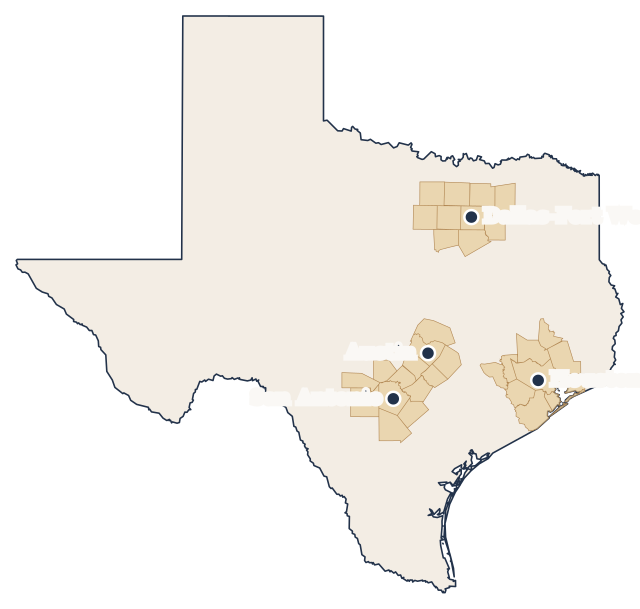
- Houston Harris County, Fort Bend County, Montgomery County, Galveston County, Brazoria County
- Dallas-Fort Worth Dallas County, Tarrant County, Collin County, Denton County, Johnson County, Parker County, Ellis County
- San Antonio Bexar County, Comal County, Guadalupe County
- Austin Travis County, Williamson County, Hays County
Questions Texas families ask
Who can order a Texas death certificate?
For deaths in the past 25 years, immediate family: the child, spouse, parent, sibling or grandparent, with a valid photo ID. Anyone else needs legal papers that show a direct interest, such as an insurance policy that names them.[2]
How long does a Texas death certificate take?
Walk-in orders at the Austin office are usually same day. Online orders are mailed 20 to 25 business days after the request, mail orders 6 to 8 weeks, and expedited mail orders about 4 weeks.[2]
Who investigates a death in Texas?
Counties with a medical examiner's office send unexpected and unnatural deaths there. In counties without one, a justice of the peace holds the inquest. Counties over 2.5 million people must have a medical examiner.[7]
When you're ready, their page is here
Their story, told your way, with no one limiting it. Start with their name.
Sources and the dates we checked them (22)
Each number on this page points to the official page we read, with the date we checked it.
- [1]Texas DSHS, Death Records, checked November 11, 2026
- [2]Texas DSHS, mail application for a death record (VS-142, January 2026), checked November 11, 2026
- [3]Texas Health and Safety Code: §193.003 · §193.005(a) and (b) · §193.005, checked November 11, 2026
- [4]Texas DSHS, Costs and Fees, checked November 11, 2026
- [5]Medicare, Medicare Hospice Benefits (CMS Product No. 02154, March 2026), checked November 11, 2026
- [6]Texas Health and Safety Code: §671.001(d) · §671.001(b) and (c), checked November 11, 2026
- [7]Texas Code of Criminal Procedure: Art. 49.04(a)(6) and (7) · Art. 49.25, Sec. 7(a) · Art. 49.07(a) and (b) · Art. 49.25, Sec. 8 · Art. 49.05(e) · Art. 49.02 · Art. 49.25, Sec. 6(a)(2) and (6) · Art. 49.25, Sec. 6(a)(1) · Art. 49.01(4) · Art. 49.25, Sec. 6(a)(8) · Art. 49.25, Sec. 10 · Art. 49.25, Sec. 1 and 1-a · Art. 49.02 and 49.04 · Art. 49.25, Sec. 6 · Chapter 49, checked November 11, 2026
- [8]CDC, Importation of Human Remains into the U.S. for Burial, Entombment, or Cremation (last reviewed Dec. 4, 2025), checked November 11, 2026
- [9]Texas Secretary of State, Apostille/Authentication of Documents, checked November 11, 2026
- [10]Texas Legislature, H.B. 1610 (89R), enrolled text, checked November 11, 2026
- [11]Texas Health and Safety Code: §711.002 · §711.008, checked November 11, 2026
- [12]25 Texas Administrative Code §181.4, checked November 11, 2026
- [13]Texas Health and Safety Code: §716.004 · §716.004 and §716.051 · §716.304, checked November 11, 2026
- [14]Texas Funeral Service Commission, Facts About Funerals, checked November 11, 2026
- [15]U.S. EPA, Burial at Sea, checked November 11, 2026
- [16]25 Texas Administrative Code §181.2, checked November 11, 2026
- [17]FTC, The FTC Funeral Rule, checked November 11, 2026
- [18]42 U.S.C. §402(i), checked November 11, 2026
- [19]VA, Veterans burial allowance, checked November 11, 2026
- [20]Texas Health and Safety Code §694.002, checked November 11, 2026
- [21]Texas Funeral Service Commission, How to File a Complaint, checked November 11, 2026
- [22]Texas Department of Banking, File a Complaint, checked November 11, 2026
This guide is general information, not legal advice. Our promise to families